Case Study: AI-Powered Project Hunting & BD Automation System for EPCM Companies
Advanced BD Solutions
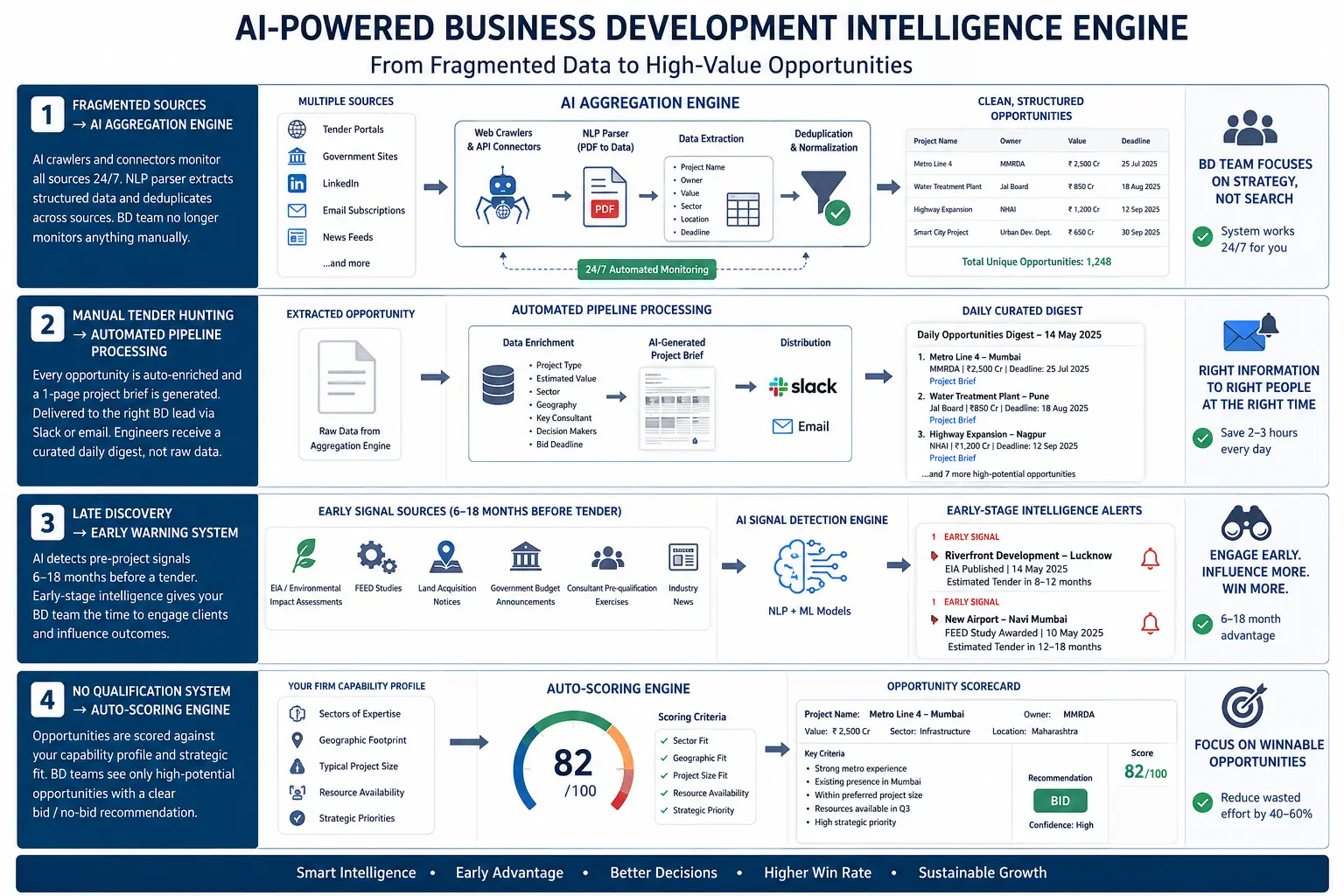
An EPCM-focused business development automation platform was designed to help engineering and infrastructure companies streamline project discovery, qualification, pipeline management, and outbound engagement.
The system consolidated fragmented project intelligence sources into a centralized AI-driven pipeline engine capable of:
- Monitoring multiple tender and project sources automatically
- Identifying high-fit opportunities using AI qualification
- Enriching project and stakeholder intelligence
- Automating outbound cold outreach and follow-ups
- Improving visibility into upcoming project pipelines
- Reducing manual effort across BD and proposal teams
The solution created a scalable framework for EPCM companies to transition from reactive tender hunting to proactive opportunity intelligence.
Industry Context
EPCM business development teams operate in highly fragmented and competitive environments.
Most organizations rely on:
- Tender portals
- Government procurement websites
- Consultant networks
- Email subscriptions
- Excel trackers
- Manual LinkedIn monitoring
- Internal spreadsheets
- WhatsApp communication
As project volumes increase, BD teams struggle to:
- Discover projects early enough
- Filter relevant opportunities efficiently
- Track stakeholders consistently
- Coordinate proposal activities
- Maintain accurate pipeline visibility
- Scale outreach across multiple sectors and geographies
This creates operational inefficiencies and directly impacts bid conversion rates.
Problem Statement
The EPCM client faced major operational bottlenecks inside its business development workflow.
Key Challenges
1. Fragmented Opportunity Discovery
Project information was spread across multiple disconnected sources, forcing teams to manually monitor and aggregate opportunities.
2. Excessive Manual Tender Hunting
Business development engineers spent significant time searching portals, downloading tender documents, and maintaining trackers.
3. Delayed Project Visibility
The company frequently discovered opportunities late in the bid cycle, reducing its ability to influence specifications and establish early relationships.
4. Weak Qualification Process
Teams lacked a structured mechanism to prioritize projects based on capability, geography, sector, and strategic fit.
5. Proposal Team Overload
Proposal and estimation teams received inconsistent and late-stage project information, creating operational stress and rushed submissions.
6. Lack of Centralized Pipeline Intelligence
Business development data existed across spreadsheets and email threads with no unified visibility into project stages or stakeholder engagement.
7. Inconsistent Outreach Follow-Up
Cold outreach and relationship-building activities were highly manual, resulting in missed follow-ups and low engagement consistency.
Solution Overview
A layered AI-powered EPCM business development architecture was developed to automate the entire project hunting and opportunity engagement lifecycle.
The system combined:
- Signal ingestion
- AI qualification
- Opportunity intelligence
- CRM-style pipeline management
- Automated outreach sequencing
- Follow-up automation
- Stakeholder tracking
into a centralized operational workflow.
System Architecture
A layered AI-powered EPCM business development architecture was developed to automate the entire project hunting and opportunity engagement lifecycle.
Layer 1 — Signal Ingestion
The platform continuously monitored multiple project intelligence sources including:
- Tender portals
- Government procurement websites
- EPC databases
- LinkedIn updates
- Consultant announcements
- Industry publications
- Client websites
- Email alerts
This removed the dependency on manual tender tracking.
Layer 2 — Data Processing & Structuring
Incoming data was automatically parsed, normalized, categorized, tagged, and structured into project records. The system extracted:
- Project scope
- Industry sector
- Geography
- Bid deadlines
- Project owners
- Consultants
- Estimated value
- Qualification requirements
This created a standardized project intelligence layer.
Layer 3 — AI Qualification Engine
An AI-driven scoring engine evaluated opportunities based on sector alignment, technical capability, geographic fit, project value, strategic priority, bid probability, and existing relationships. The system prioritized high-fit opportunities and reduced wasted effort on low-probability bids.
Layer 4 — Centralized Opportunity Hub
Qualified opportunities were pushed into a centralized pipeline system. BD teams gained visibility into opportunity stages, stakeholder engagement, proposal status, follow-up timelines, bid deadlines, relationship mapping, and probability scoring, replacing fragmented spreadsheet-based tracking.
Layer 5 — AI Outreach & Follow-Up Automation
A dedicated AI outreach layer automated cold email sequences, LinkedIn outreach, follow-up reminders, stakeholder engagement tracking, and meeting scheduling workflows. The outreach engine personalized communication based on project type, industry segment, stakeholder role, company profile, and previous engagement history, enabling scalable outbound business development operations.
Workflow Transformation
Before Implementation (Manual Workflow)
- BD teams manually searched portals daily
- Teams maintained disconnected Excel trackers
- Opportunities were filtered manually
- Follow-ups depended on individual discipline
- Proposal teams received late information
- Management lacked forecasting visibility
The process was highly reactive and resource-intensive.
After Implementation (AI-Augmented Workflow)
- Opportunity signals were captured automatically
- AI filtered and prioritized high-fit projects
- Pipeline visibility became centralized
- Stakeholder intelligence was structured
- Outreach sequences became automated
- Proposal coordination improved significantly
- Leadership gained real-time pipeline visibility
The workflow shifted from reactive tender hunting to proactive opportunity intelligence.
Operational Impact
Business Development Efficiency
The automation reduced repetitive manual effort across BD operations, allowing teams to focus more on client engagement, strategic relationship building, early project positioning, and proposal quality improvement.
Faster Opportunity Discovery
The company gained earlier visibility into upcoming projects, tender announcements, consultant activity, CAPEX developments, and bid timeline changes. This improved response readiness and market positioning.
Improved Pipeline Visibility
Leadership teams gained centralized visibility into active opportunities, sector distribution, geographic pipeline, bid conversion status, and forecasting metrics. This improved decision-making and resource planning.
Better Qualification Discipline
AI-assisted scoring reduced time spent on low-fit opportunities, unqualified bids, low-margin projects, and misaligned sectors. This improved overall bid efficiency.
Scalable Outreach Operations
The outreach automation layer enabled higher outbound consistency, better follow-up discipline, increased stakeholder touchpoints, and reduced manual communication effort. The organization could scale business development without proportionally increasing headcount.
Strategic Outcomes
The system enabled the EPCM organization to transition toward centralized opportunity intelligence, AI-assisted business development, automated stakeholder engagement, predictive pipeline management, and data-driven bid prioritization. The architecture created a repeatable and scalable foundation for future BD growth.
Key Capabilities Delivered
Opportunity Intelligence
- Multi-source project monitoring
- Automated tender aggregation
- Real-time opportunity alerts
AI Qualification
- Project scoring
- Sector alignment analysis
- Strategic prioritization
Pipeline Management
- Unified project visibility
- Stakeholder tracking
- Proposal coordination
Outreach Automation
- Cold email sequencing
- LinkedIn engagement
- Automated follow-up workflows
Reporting & Visibility
- Pipeline dashboards
- Forecast tracking
- Opportunity analytics
Conclusion
The EPCM AI business development architecture demonstrated how automation and AI can modernize traditional project hunting workflows. By integrating opportunity intelligence, AI qualification, centralized pipeline management, and outreach automation into a unified system, the organization significantly improved operational efficiency and business development scalability.
The platform established a foundation for faster project discovery, better opportunity qualification, higher productivity, improved engagement consistency, and scalable growth operations, positioning the EPCM organization to compete more effectively in complex and competitive infrastructure markets.